
The Child Whisperer by Carol Tuttle. This lady categorizes children into what she calls “Energy Types.” According to her theory, each child has two dominant types. What I found helpful was not only the definition of each personality but her lists of how they are applicable to parents. She explains how to identify hidden messages in your child’s behavior and how to help motivate them in a positive way.
The following lists are taken from Carol Tuttle’s book:
“Each type:
1. The Fun-Loving Child
The way they connect – social
Their needs – have fun, happy parents
Described as – lighthearted, friendly
2. The Sensitive Child
The way they connect – Emotional
Their needs – feelings heard, connected family
Described as – gentle, tender, mindful
3.The Determined Child
The way they connect – Physical
Their needs – new experiences with support from parents
Described as -busy, persistent, energetic
4. The More Serious Child
The way they connect – Intellectual
Their needs – respect, given and received
Described as – efficient, analytical, thorough”
When your child is acting out or having a tantrum, Carol Tuttle gives several questions for you to ask yourself. The questions differ for each energy type.
“Fun Loving Child –
Does my child feel overly controlled?
Has my child had too much alone time?
Is something in my child’s life too serious?
The Sensitive Child –
Does my child feel unheard or dismissed?
Have my child’s plans been ignored?
Is there something in my child’s life that is too intense?
The Determined Child –
Does my child lack enough physical outlets?
Has my child been told “NO” too often lately?
Is something in my child’s life too stifling?
The More Serious Child –
Does my child need to feel more respected?
Does my child need some time to reflect and focus?
Is something in my child’s life embarrassing?”
Isn’t that awesome?! These questions blew my mind when I read this book. Here are a couple examples of how this simple instruction changed the way I look at my children and assess their behavior.
Example – One of my sons started acting out much more than normal and I was having a hard time being patient with his disruptive and rude behavior. When I read this book, I instantly knew that he was a type 1, (Fun Loving). I realized that he was at home (with only his baby sister and me) far too often. He needed time to socialize with friends. I scheduled playdates with kids his age and went to the park with neighbors. We planned a social event about twice a week and it helped him tremendously. I saw an instant change in him. He needed to have friends. Now he talks about his friends at the dinner table instead of acting out!
Example – Another one of my sons is a type 4 (Serious). He asks a lot of questions that are important to him, has difficulty understanding sarcasm, and is careful in the decisions and choices he makes. He loves to show me his detailed Lego creations that he spends hours building. When he asks for my undivided attention while I am doing the dishes and I say, “oh I’ll be done in 15 minutes,” he will leave me and then come back in exactly 15 minutes. Since I know this about him, it is easier to give him the respect he desires. He used to become frustrated and angry more often before I learned of his “energy type.” He is a happier, more content child now that I know what types of things are important to him and how to meet his needs.
Some energy types need more one-on-one time with their parents while others need to play physical games or have more time out of the house socializing with friends. Some children need to be listened to more often while others want to be left alone on a daily basis. I guarantee that you will learn something from this book. There is something in this book for every parent.
The Five Love Languages by Gary D. Chapman. After he wrote this book, it was so popular he wrote several other books tailored to children, teens, singles and so on. It is pretty much the same stuff and you can get it all from this one book. He teaches there are five main ways a person can feel loved.
The following list of love languages and definitions is taken from Gary Chapman’s book.
“#1: Words of Affirmation Actions don’t always speak louder than words. If this is your love language, unsolicited compliments mean the world to you. Hearing the words, “I love you,” are important—hearing the reasons behind that love sends your spirits skyward. Insults can leave you shattered and are not easily forgotten.
#2: Quality Time For those whose love language is spoken with Quality Time, nothing says, “I love you,” like full, undivided attention. Being there for this type of person is critical, but really being there—with the TV off, fork and knife down, and all chores and tasks on standby—makes your significant other feel truly special and loved. Distractions, postponed dates, or the failure to listen can be especially hurtful.
#3: Receiving Gifts Don’t mistake this love language for materialism; the receiver of gifts thrives on the love, thoughtfulness, and effort behind the gift. If you speak this language, the perfect gift or gesture shows that you are known, you are cared for, and you are prized above whatever was sacrificed to bring the gift to you. A missed birthday, anniversary, or a hasty, thoughtless gift would be disastrous—so would the absence of everyday gestures.
#4: Acts of Service Can vacuuming the floors really be an expression of love? Absolutely! Anything you do to ease the burden of responsibilities weighing on an “Acts of Service” person will speak volumes. The words he or she most want to hear: “Let me do that for you.” Laziness, broken commitments, and making more work for them tell speakers of this language their feelings don’t matter.
#5: Physical Touch A person whose primary language is Physical Touch is, not surprisingly, very touchy. Hugs, pats on the back, holding hands, and thoughtful touches on the arm, shoulder, or face—they can all be ways to show excitement, concern, care, and love. Physical presence and accessibility are crucial, while neglect or abuse can be unforgivable and destructive.”
This book is incredibly versatile and can be used in every type of relationship: family, friend, or even co-worker.
I feel loved when someone gives me a thoughtful gift, kind notes, or honest praise. I have a child who feels loved when I praise him, and a good friend who feels loved when we spend uninterrupted quality time together. (Which means I have to put down my phone)
I also appreciate finding out what types of things my children really don’t care about. It has been so helpful to me to find out what each family member’s love language is. In a conversation I had the other day with a wonderful woman, she mentioned that every year she would invest much time and effort in making her husband’s birthday special… only to realize 30 years later that he really didn’t care about gifts at all. He just wanted to spend quality time with her.
Children have their own love languages and as parents, we often take that for granted. We sometimes assume that they should feel loved because of our acts of service towards them. I am a stay at home mom and am constantly serving my children by cleaning, doing their laundry, cooking meals, and helping them with their homework. None of my children feel especially loved because I do these things for them. To them, it is just my job as their mom. Unless your child’s love language is acts of service, they most likely won’t interpret all your hard work as showing love.
Once I discovered my children’s love languages, it changed the way I view and treat them. I now understand why certain things are important to them. I am also better able to express love for them in a way they will recognize, and respond to. I am able to show love for them in a way they feel loved.
You can download “The 5 Love Languages” as an e-book for free HERE
You can also take the test online HERE and find out what your most dominant love language is:
]]>
Buy Healthy Snacks – I love to snack. I usually just snack the whole day till dinner. This means I need plenty of healthy snacks around the house. If I can use self-control at the grocery store, then I don’t have to use so much of it at home. If I don’t buy Oreo’s, then they will never end up in my cupboard tempting me to eat the whole package in two days, which I did in college… often. Now I buy fruit: apples (Pink Lady are my favorite), oranges, bananas, fresh pineapple, strawberries, blackberries, raspberries, blueberries. I eat the berries with yogurt and granola. Yummm! I get my veggies in with cucumbers, cherry tomatoes, and celery dipped in cilantro avocado dressing! I grab a string cheese and bag of coconut strips on my way out the door instead of a coke and bag of chips. Lately, I’ve found white cheddar rice cakes are surprisingly yummy. Try them if you haven’t yet.
Drink Water – I have a big (32 ounce) water bottle that I keep with me all day. If I get in my car to run errands, I take my water. If I sit down at my desk to work, I have my water right there. I make it a goal to take a sip whenever I see it. Do you know what water does to your body? There are so many reasons to stay hydrated. Just to name a few: it helps prevent colon and bladder cancer, helps you think clearer, helps your mood, your skin, your blood flow, and helps you lose weight. Dehydration can lead to headaches, fatigue, dizziness, electrolyte imbalance, and weight gain. Water boosts your immune system and your metabolism. Water is amazing! It pretty much helps every part of your body, so guzzle it down.
Exercise – My dad is a family doctor. He is the best one I know, and has been practicing in California for over 20 years. A few years ago I asked him a question. “You visit with different types of people every day. If you had one piece of advice for everyone, just one thing that everyone could do everyday that would drastically help them be healthier, what would it be?” His answer… “walk a mile everyday.” He said it helps your body dramatically, just to get your heart rate up and Adrenalin pumping everyday. Now, I hate running and I mean really HATE running, so I was glad he didn’t say run. He said walk. I can do that! My tip is to try new ways to get that mile in everyday, however you can. Just like my dad said, pick some activity that gets your heart rate up. It could be a brisk walk around your neighborhood, a Zumba dance class, or simply taking the stairs instead of the elevator. Just make yourself get a mile worth of steps in each day.
Get Your Sleep – Easier said than done. With all the demands of the day, how do we find time for sleep? How much sleep do we need anyway? This is what the National Sleep Foundation recommends for each age group.
Newborn: 0-3 months – 14 to 17 hours of sleep
Infant: 4-11 months – 12 to 15 hours of sleep
Toddler: 1-2 years – 11 to 14 hours of sleep
Preschooler: 3 – 5 years – 10 to 13 hours of sleep
School age: 6 – 13 years – 9 to 11 hours of sleep
Teen: 14 – 17 years – 8 to 10 hours of sleep
Adults: 18 – 64 years – 7 to 9 hours of sleep
Older Adult: 65+ 7 to 8 hours of sleep
Why do we need sleep? Good question. Many people assume that when we sleep our body shuts down and rests. That is only partly the case. Many parts of our body do rest, but our mind is still very active while we sleep. Even though we are asleep, our brain is working hard to clear out toxins and waste, while also reviewing memories and daily learning. Sleep even helps regulate your mood and appetite. So think again when you are debating on pulling an “all-nighter.” I did that several times in college. Those weren’t my healthier years.
The facts I use in my article are taken from the following site:
]]>
I used to be afraid to open my bedroom closet, for fear of being attacked by endless junk dumping on my head. Much of the time, I couldn’t close the doors all the way because of the piles of shoes on the floor. I knew it was time for a change, so I decided to give my closet a complete makeover. These are the 3 steps I took.
Step 1. Empty your entire closet and ask yourself these 3 questions.
What do I really use?
What do I want to see every day?
What do I actually want in my closet?
Step 2. Create piles. Divide and Conquer!
You may have more piles than are listed here, but these are the main ones.
Trash Pile – Trash is trash. Easy enough, right? The trick is recognizing what trash is. A T-shirt with paint stains or holes? Throw it out. Shoes that are falling apart? Throw them out. That old college T-shirt with your nickname on it? Take a picture of it. Post it on Facebook and tag all your old college roommates. Then…. throw it out.
Donate Pile – This pile is for your clothes and shoes that are still in good condition, but you don’t wear. You may consider selling them online, taking them to a second hand store for some fast cash, or simply donating them. I tend to choose to donate. There are many places you can drop off a bag of clothes and get a receipt for a tax write-off instead. It is the quickest way to get rid of your stuff and feel good about where your items are going.
Doesn’t belong Pile – I was surprised to find stuff that just belonged somewhere else. My kids were excited to see their long lost shoes and toys that had been hiding in mommy’s closet. I don’t know how they got there…
Put back Pile – This is the most important pile. This is what you will actually make room for in your newly organized closet. My advice for you, if you are like me and tend to want to keep everything, is to take the following challenge:
The Trunk Challenge…”What is the trunk challenge?” you say… well, I’ll tell you. Place all of the items you are considering getting rid of in a box or trash bag and place it in the trunk of your car and see what happens. Do you find yourself having to dig through it several times for things that you need and use, or does the bag stay unopened in your trunk for several weeks? I took the trunk challenge and ended up forgetting about my big bag of clothes in the trunk of my car. I noticed it two weeks later when I needed to use the trunk. I couldn’t even recall what I had put in the sack. Needless to say… It all was donated.
Step 3. Put everything back, in a smart way.
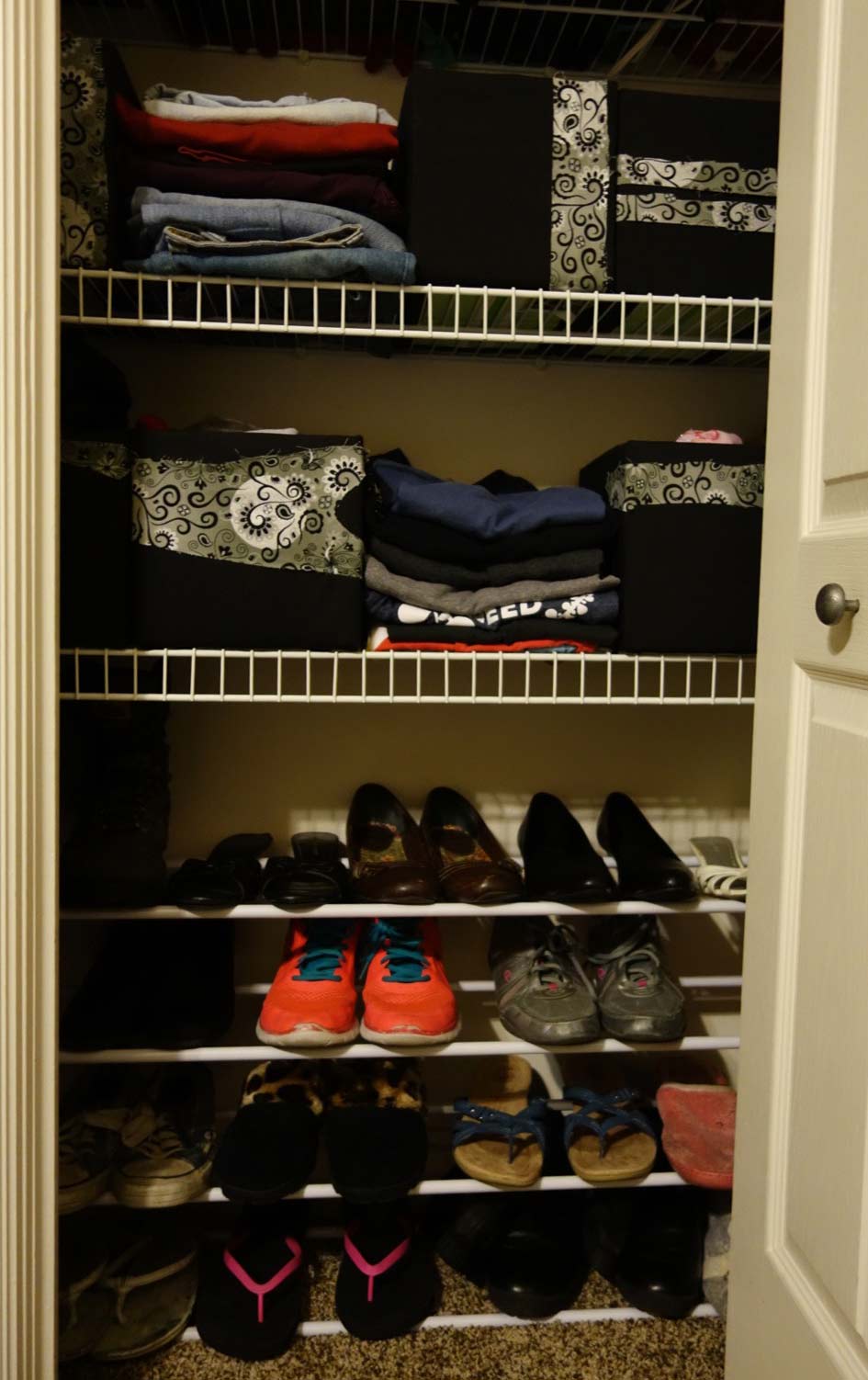 I ended up spending $15 on a shoe rack to keep my shoes from piling up and it was very worth the $15. You can see it HERE. There just wasn’t enough floor room for my shoes and they always ended up on top of each other. When I would find one shoe I wanted to wear I used to have to dig for the other match. Now, thankfully, I don’t dig anymore. I can see them all and can quickly grab the pair I need. I also made fabric covered boxes from some cardboard baby wipe boxes I’d collected. (I knew there was a reason I needed to keep those. They were just too cute and all the same size!) These boxes now carry my smaller items such as socks, nylons, and rolled up pajamas.
It was quite a process, but now I can actually use the space for the purpose it was intended… Imagine that! I feel a sense of accomplishment when I open my closet doors and know exactly what’s in there and where it is. I can see everything and I even have extra space! It may seem simple, but now when I open my closet doors I am in a happy place, not chaotic or messy, but peaceful.
Comment below and let me know how you like to organize your closet. Share with me your ideas.
]]>